
Low-Phosphorus and Sulphur-Free Biochar: the Specifications That Matter for Steel and Ferrochrome
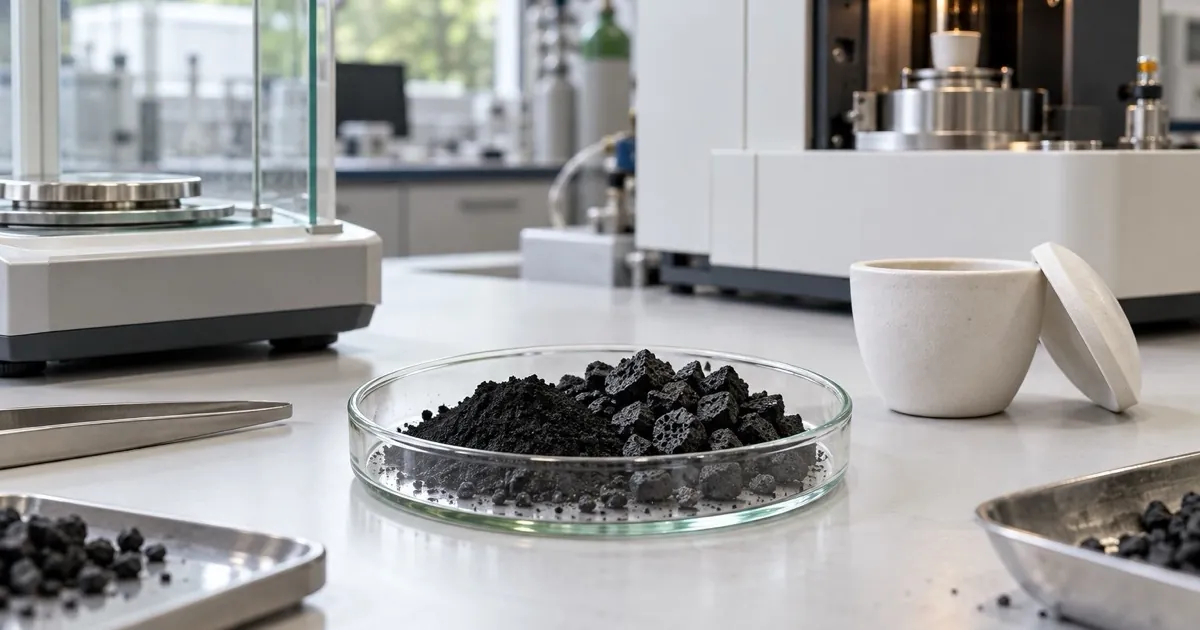
When a steel plant or ferroalloy producer starts replacing coke or anthracite with a renewable reductant, the first question is rarely about CO₂. It is about chemistry: will the new carbon bring in sulphur and phosphorus that end up in the metal? This is why sulphur free biochar and low phosphorus biochar have become a specification topic in their own right. This article explains which parameters on a certificate of analysis matter, why metallurgists care about them, and how to write a spec that a supplier can actually meet.
Why phosphorus and sulphur in the reductant matter
Everything you charge into a furnace has to go somewhere. Carbon is consumed as a reducing agent, but impurities in the reductant partly report to the slag and partly to the metal. Phosphorus and sulphur are the two elements metallurgists watch most closely, because even small amounts change how steel behaves.
- Phosphorus causes cold shortness: steel becomes brittle at low temperatures and loses impact toughness. For structural, pipe and automotive grades, P limits in the final product are tight.
- Sulphur forms iron sulphide (FeS), which melts at a lower temperature than steel and collects at grain boundaries. The result is hot shortness – cracking during rolling and forging – and lower ductility.
- Ferroalloys are especially sensitive. In ferrochrome or ferromanganese smelting, a large share of the phosphorus in the charge passes into the alloy, and from there into every steel the alloy is added to.
Removing these elements later costs money. Desulphurisation and dephosphorisation need extra fluxes, extra slag volume, extra treatment time and sometimes extra process steps. Dephosphorisation of a ferroalloy after smelting is particularly difficult. It is almost always cheaper to keep P and S out of the furnace in the first place – which is why the reductant specification matters as much as the ore specification.
Rule of thumb: every unit of phosphorus or sulphur you do not charge is a unit you do not have to remove. A clean reductant is a process cost saving, not only a quality feature.
Biochar specifications: the key CoA parameters explained
A certificate of analysis (CoA) for metallurgical biochar usually lists the same set of parameters as for coke or anthracite. Here is what each one means and why it matters at the furnace. Exact values per grade belong in the CoA itself and in your contract – they depend on the furnace and the product you make.
| Parameter | What it means | Why the metallurgist cares |
|---|---|---|
| Fixed carbon | The share of solid carbon left after moisture, volatiles and ash are removed | This is the carbon that actually reduces oxides. Higher fixed carbon means less material per tonne of metal |
| Volatile matter | Gases and tars released on heating | High volatiles burn off early, add off-gas load and make carbon consumption less predictable |
| Ash | The mineral residue after combustion | Ash goes to slag: more slag volume, more energy, more fluxes |
| Moisture | Free water in the material | Water costs energy to evaporate and distorts the carbon balance if not corrected for |
| Sulphur (S) | Total sulphur content | Transfers into metal, causes hot shortness and drives desulphurisation costs |
| Phosphorus (P) | Total phosphorus content | Transfers into steel and especially ferroalloys, causes cold shortness, hard to remove |
| Calorific value | Energy released on combustion | Relevant where the carbon also supplies heat, e.g. charge carbon or injection |
| Particle size | Fraction range, e.g. 0–3 mm up to 25–50 mm | Fines can be blown out or block gas flow; lumps must suit the feeding and injection equipment |
For context: Pamecarbon's calcined biocarbon is supplied with 85–95% fixed carbon, and the sulphur-free and phosphorus-free grades with from 80% fixed carbon, with minimal moisture, ash and volatile matter. Every batch ships with a CoA from an independent laboratory covering all of the parameters above. See the full product range on the biochar products page.
How feedstock and calcination keep sulphur and phosphorus low
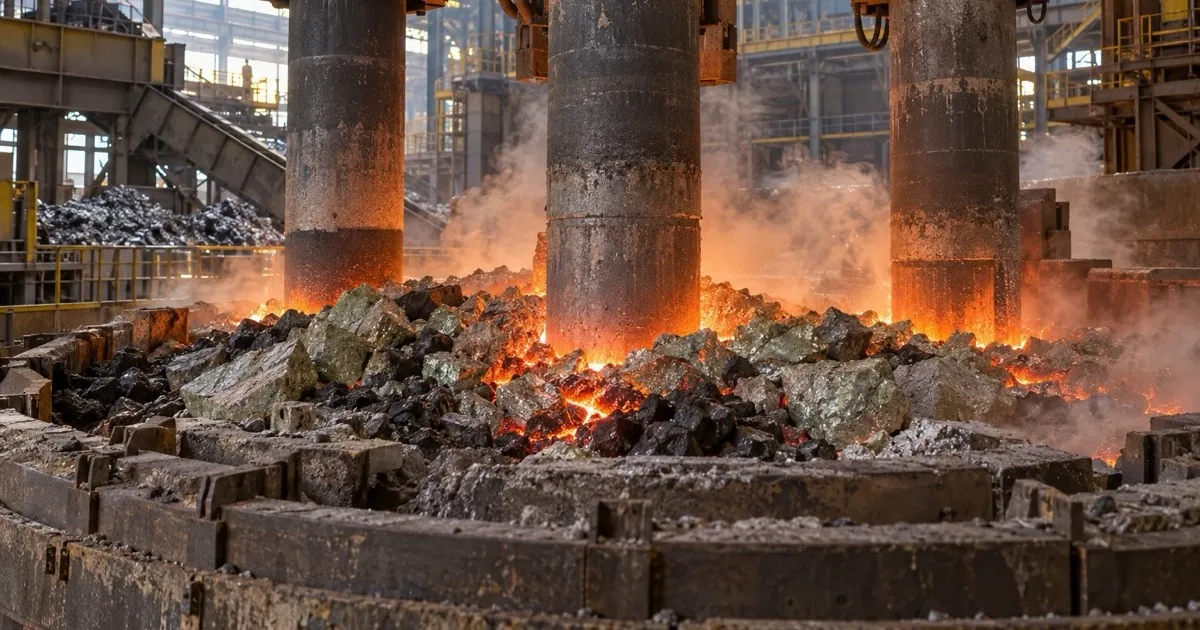
Fossil reductants inherit their impurities from geology. Coal and the coke made from it carry sulphur and phosphorus from the original deposit, and there is little a coke plant can do about it. Biochar is different: its chemistry is set by the choice of biomass and by the thermal process.
Pamecarbon uses exclusively agricultural production waste – not wood. Processing residues that would otherwise decompose and release CO₂ are converted into carbon, which makes production carbon negative. Selecting and controlling the agricultural feedstock is also what keeps sulphur at ultra-low to zero levels and allows the phosphorus content to be adjusted to order. That is the basis for two dedicated product lines: phosphorus-free / low-phosphorus biocarbon and sulphur-free biocarbon.
Calcination then does the rest. Heating the char further drives off volatile matter, raises fixed carbon and, just as importantly, makes the properties more stable from batch to batch. For a furnace operator, predictability is often worth as much as the headline numbers. If you want the background on why the same product is called biochar, biocoal and biocarbon, read our article on calcined biocarbon vs biochar vs biocoal.
Ferrochrome and submerged arc furnaces: what else to check
Ferrochrome is smelted in submerged arc furnaces (SAF), traditionally with coke or coal as the reductant. Biocarbon can partially replace them, but the SAF adds requirements beyond chemistry:
- Mechanical strength. The charge must hold up under the burden without crushing. Weak material breaks down and reduces bed permeability.
- Fines. Too many fines block the gas flow through the charge. Specify the fraction carefully and agree on how fines are handled during transport and charging.
- Electrical resistivity. Biocarbon typically has a higher electrical resistivity than coke. In a SAF this can be an advantage, as it can help keep the electrodes deeper in the burden.
How much biocarbon a given furnace can take depends on the furnace, the ore and the alloy grade, and should be established through trials, usually starting with a partial substitution. In EAF steelmaking the case is simpler: biocarbon is a direct substitute for charge carbon and injection carbon for slag foaming. More on this and on the CBAM economics in our article on biocoal for steelmaking and CBAM.
How to write a biochar specification for your supplier
A good specification protects both sides: you get a reductant your process can use, and the supplier knows exactly what to deliver. Use this checklist when you prepare an enquiry:
- Application and furnace type – EAF, SAF, blast furnace (PCI or nut coke substitution), ladle recarburisation, other.
- Fixed carbon – the minimum you need, stated on a defined basis (dry or as received).
- Maximum sulphur and phosphorus – derived from your product limits and your current reductant, not from a generic table.
- Volatile matter, ash and moisture – maximum values that fit your energy and slag balance.
- Fraction – for example 0–3 mm for injection or larger fractions up to 25–50 mm for charging; non-standard fractions can be requested.
- Packaging and volume – big bags of 500–1000 kg, 25 kg bags or bulk; trial lot and expected monthly tonnage.
- Documentation – CoA per batch from an independent lab, feedstock-origin documents and MSDS if your sustainability or safety teams need them.
- Analysis method and sampling – agree how and where the material is sampled, so that your incoming inspection and the supplier's CoA compare like with like.
Many questions about grades, fractions and documentation are already answered in our biochar FAQ.
Request samples and a certificate of analysis
The fastest way to check whether sulphur free biochar or a low phosphorus biochar grade fits your process is to test it. Pamecarbon sends 2–5 kg samples with laboratory data within 5–7 business days, and every commercial batch ships with its own CoA. Send us your target specification via the contact page and we will propose a matching grade and fraction.
Frequently asked questions
What is sulphur free biochar?
It is a biochar or biocarbon grade with ultra-low to zero sulphur content, made from selected feedstock. Pamecarbon produces it from agricultural waste for metallurgy, where sulphur in the reductant would otherwise pass into the metal.
Why does a low phosphorus biochar matter for ferroalloys?
A large share of the phosphorus in the charge passes into ferroalloys such as ferrochrome and then into the steel they are added to. Phosphorus causes cold shortness and is difficult and expensive to remove after smelting.
What fixed carbon does phosphorus free biochar have?
Pamecarbon's sulphur-free and phosphorus-free grades have from 80% fixed carbon, and calcined biocarbon has 85–95%. Exact values for each grade are stated in the certificate of analysis.
Which parameters are on the biochar certificate of analysis?
Every batch ships with an independent lab CoA covering fixed carbon, volatile matter, ash, moisture, sulphur, phosphorus and calorific value. Feedstock-origin documents and MSDS are available on request.