
Calcined Biochar Explained: Why Biochar, Biocoal and Biocarbon Are One Product
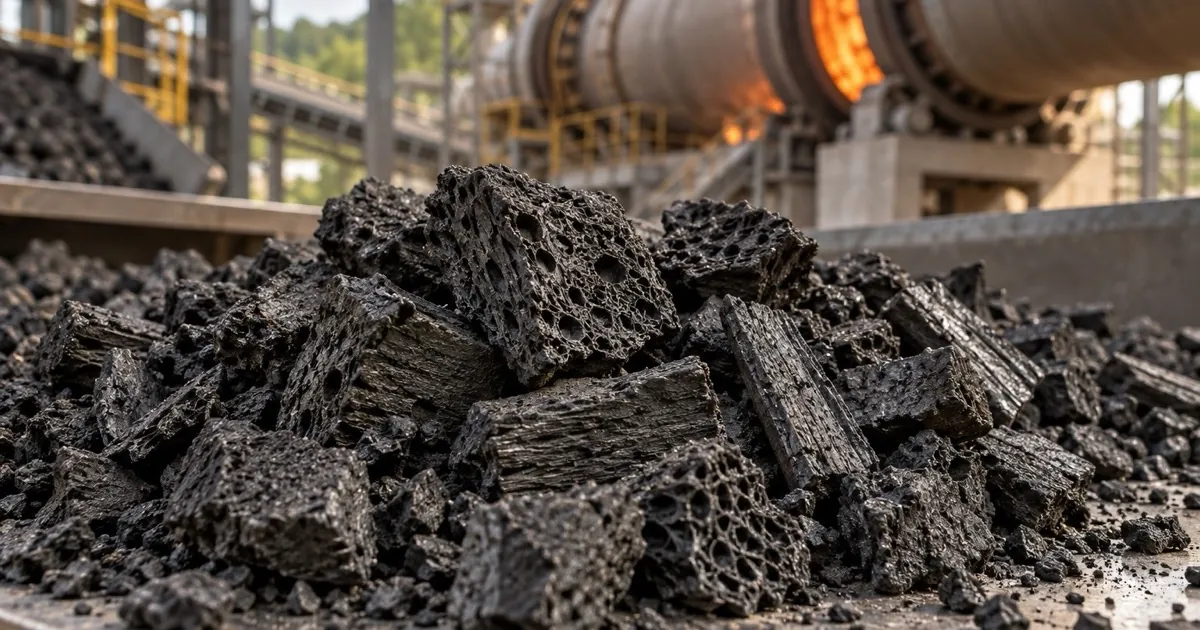
Ask five steel buyers what they call a renewable carbon reductant and you may get five answers: biochar, biocoal, biocarbon, bio-coke or green coke. In most cases they mean the same material — calcined biochar, also called calcinated biocarbon. This article explains what calcined biocarbon is, why the market uses so many names for it, how calcination changes the material, and how it compares with anthracite, coke and ordinary raw biochar.
What is calcined biocarbon?
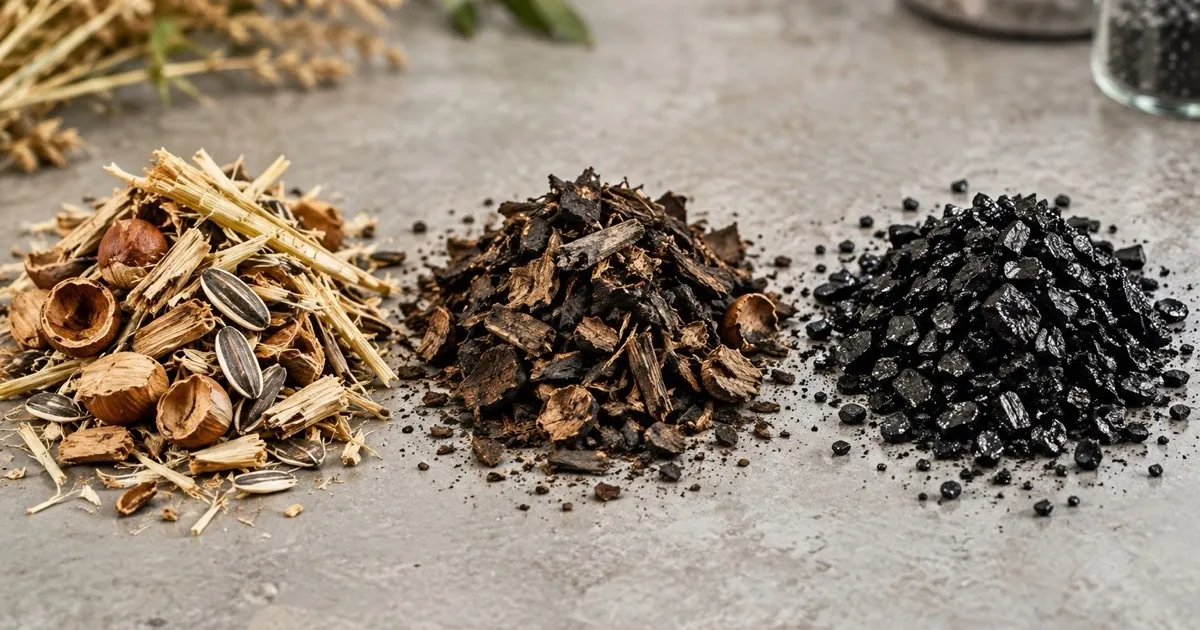
Calcined biocarbon is a high-carbon solid made from biomass and then treated at high temperature in the absence of air. The first step, pyrolysis, turns plant residues into char. The second step, calcination, drives off most of the remaining volatile compounds and leaves a dense, carbon-rich product with predictable behaviour in a furnace.
The result is a material that does the same job as fossil carbon carriers in metallurgy — it acts as a reducing agent and a carbon source — but its carbon comes from plants, not from coal seams. At Pamecarbon, calcined biochar typically reaches 85–95% fixed carbon, with minimal moisture, ash and volatile matter. Exact values for each grade are stated in the Certificate of Analysis that ships with every batch.
In short: calcined biocarbon is biochar that has been engineered for industry rather than for soil. The plant origin gives it the climate profile; the calcination gives it the technical profile that furnace operators expect from anthracite or coke.
Biochar, biocoal, biocarbon, bio-coke: why so many names?
Terminology for renewable carbon in metallurgy is not standardised yet. The industry is young, buyers come from different backgrounds, and each language has its own habits. It is common for a client to start an enquiry asking for "biocoal" and finish the same email thread talking about "biocarbon". Technically, they are asking for the same calcined material.
- Biochar — the most widely used term globally. It covers everything from garden soil improvers to metallurgical reductants, which is why it needs a qualifier.
- Biocoal (bio-coal) — popular with steel and ferroalloy buyers because it signals "a coal replacement". It often appears in tenders for coal and anthracite substitution.
- Biocarbon — the most technically accurate name; it emphasises the carbon content rather than the origin.
- Bio-coke / green coke — used when the material is meant to substitute part of the coke in a process.
Agricultural biochar vs metallurgical grade
The real distinction is not the name but the grade. Agricultural biochar — known in German as Pflanzenkohle — is designed for soils, compost and animal feed. It is valued for porosity and water retention, and its volatile content and carbon level can vary. Metallurgical biochar is designed for furnaces: high fixed carbon, low volatiles, controlled ash, and tightly limited sulphur and phosphorus. Calcination is the step that separates the two.
This matters when you search for suppliers. A product sold as "biochar" may be an excellent soil amendment and still be unsuitable for a submerged arc furnace. A product sold as "biocoal" may in fact be calcined biocarbon with 90% fixed carbon. Always ask which grade is meant and what the laboratory data shows.
Biochar, biocoal and biocarbon are names; calcination is what makes the material a reliable metallurgical reductant. When you compare offers, compare the Certificate of Analysis, not the label.
How calcination works and what it changes
Calcination is a controlled high-temperature treatment of the char in an oxygen-free environment. It continues the carbonisation process that pyrolysis started and removes the volatile compounds that remain bound in raw biochar. Three things change as a result.
- Fixed carbon rises. As volatiles leave, the share of stable, solid carbon increases — for calcined biochar to the 85–95% range. More fixed carbon means more reducing power per tonne delivered.
- Volatile matter falls. Low volatiles mean less gas and tar released in the furnace, more predictable off-gas handling and safer storage.
- Properties become stable. Calcined biocarbon behaves the same from batch to batch. For a metallurgist, predictability is often as important as the carbon number itself.
Because the feedstock and process are controlled, impurity levels can also be managed. Pamecarbon produces dedicated grades with low-phosphorus and sulphur-free biochar for applications where P and S from the reductant would end up in the metal.
Calcined biochar vs anthracite, coke and raw biochar
How does calcined biocarbon compare with the fossil materials it replaces and with uncalcined biochar? The table below gives a qualitative overview. Precise figures depend on the grade and are always confirmed by laboratory analysis.
| Property | Calcined biocarbon | Anthracite / coke | Raw (non-calcined) biochar |
|---|---|---|---|
| Fixed carbon | High: 85–95% | High | Lower and variable |
| Volatile matter | Low | Low (coke) to moderate | Elevated |
| Sulphur | Very low; sulphur-free grades available | Often significant | Low, depends on feedstock |
| Phosphorus | Low; adjustable to order | Varies by source | Not controlled |
| Batch-to-batch consistency | Stable and predictable | Stable | Variable |
| Carbon origin | Biogenic (agricultural waste) | Fossil | Biogenic |
| Main use | Metallurgical reductant, carbon carrier | Metallurgical reductant, fuel | Soil, compost, feed |
The key point of the comparison: calcined biochar closes most of the technical gap between raw biochar and fossil coal, while keeping the climate advantage of biogenic carbon. That is why "biochar vs coal" is increasingly a question of furnace trials rather than of principle.
Feedstock: agricultural waste, not wood
Not all biocarbon is equally sustainable. A common concern about biomass reductants is deforestation. Pamecarbon's calcined biocarbon is made exclusively from agricultural production waste — not from wood. No trees are cut to make it.
These processing residues would otherwise decompose and release their carbon back into the atmosphere as CO₂. Turning them into stable calcined biochar locks that carbon into a useful product, which makes the production carbon negative. For buyers reporting on Scope 1 emissions or preparing for CBAM, feedstock-origin documents are available on request alongside the CoA.
Where calcined biocarbon is used
Calcined biocarbon is used wherever industry needs a carbon reductant or carbon carrier and wants to cut fossil emissions. Typical applications include:
- Steelmaking — charge carbon and injection carbon for slag foaming in electric arc furnaces; partial substitution of PCI coal or nut coke in blast furnaces, depending on the furnace and after trials.
- Ferroalloys — partial replacement of coke and coal as a reductant in ferrochrome and other ferroalloy production.
- Other industries — anywhere a renewable substitute for coal, anthracite or coke is needed.
According to independent research, replacing fossil coal with biochar can cut specific CO₂ emissions per tonne of steel by 70–90%. Biogenic carbon from sustainable biomass is also counted as zero-emission under EU ETS rules — a growing advantage now that CBAM has entered its definitive phase. We cover this in detail in biocoal for steelmaking and CBAM. For an overview of all use cases, see our applications of metallurgical biocarbon.
How to request specifications and samples
The fastest way to know whether calcined biochar fits your process is to look at the numbers and run a trial. Pamecarbon offers four product lines — calcined biocarbon, low-phosphorus biocarbon, sulphur-free biocarbon and biocoal for metallurgy — described on our calcined biocarbon products page.
- Every batch ships with a Certificate of Analysis from an independent lab: fixed carbon, volatile matter, ash, moisture, sulphur, phosphorus and calorific value.
- Fractions from 0–3 mm up to 25–50 mm; non-standard sizes on request.
- Samples of 2–5 kg are dispatched within 5–7 business days, with lab data.
- Shipments leave from the ports of Samsun and Istanbul and reach anywhere in Europe in about a week.
Answers to common questions about grades, packaging and terminology are collected in our biochar FAQ. Ready to test? Request a sample or a CoA and tell us your process, required fraction and volume.
Frequently asked questions
Are biochar, biocoal and biocarbon the same product?
In metallurgy, usually yes. The terminology is not standardised yet, and buyers use biochar, biocoal, biocarbon or bio-coke for the same calcined biocarbon. What matters is the grade and the Certificate of Analysis, not the name.
What is the difference between calcined and raw biochar?
Calcined biochar has gone through an additional high-temperature treatment without air. This removes most volatiles, raises fixed carbon to 85–95% and makes the properties stable from batch to batch, which raw biochar cannot guarantee.
Is Pamecarbon's calcined biochar made from wood?
No. It is made exclusively from agricultural production waste, with no wood and no deforestation. Because these residues would otherwise decompose and release CO₂, the production is carbon negative.
How can I get a sample of calcined biocarbon?
Contact us via info@pamecarbon.com or +90 543 916 74 19. Samples of 2–5 kg are sent within 5–7 business days together with laboratory data.